
2D Backward-Facing Step: Validation (SA)
validation
Overview
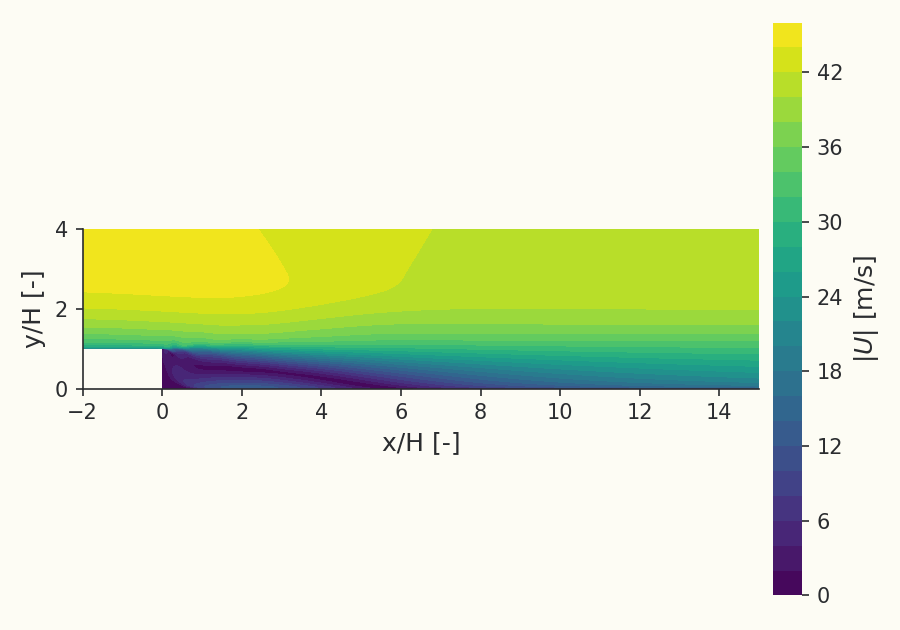
The backward-facing step is a canonical test of how a turbulence model handles separation and reattachment. As the incoming boundary layer passes the step lip it detaches into a free shear layer, a recirculation bubble forms in the corner, and the flow reattaches on the floor some distance downstream. The length of that bubble, together with the recovery of wall pressure and skin friction behind it, probes how a RANS closure predicts both the spreading of the separated shear layer and the adverse-pressure recovery that brings the flow back to the wall.
This case reproduces the Driver & Seegmiller (1985) experiment, a long-standing benchmark on the NASA Turbulence Modeling Resource. Luminary's Spalart–Allmaras solution is compared to the measured lower-wall pressure and skin friction and to the NASA CFL3D reference code computed on the same grid.
Problem Setup
The step height is , the free-stream Mach number is , and the Reynolds number based on step height is . The fluid is ideal-gas air with Sutherland viscosity. The inlet is placed upstream of the step so that a uniform inflow develops into the correct turbulent boundary layer by the time it reaches the lip, no inflow profile is prescribed. The outlet uses a back-pressure outflow set slightly above free-stream to match the mild streamwise pressure gradient of the tunnel. The step face, the floor upstream and downstream of the step, and the opposite tunnel wall are all no-slip adiabatic walls; the spanwise faces are symmetry planes for this quasi-two-dimensional computation.
The mesh is the NASA TMR's own published structured grid for this geometry, a point-matched multiblock family stitched here into a single conformal grid. Using that grid means Luminary and CFL3D are solving on identical points, so any difference is a genuine model-and-solver difference rather than a grid effect. The discretization is second order and the solution is advanced until the mean flow reaches a statistically steady state.
Quantities of Interest
The validation quantities are the lower-wall pressure coefficient and skin-friction coefficient , both reported in step heights along the floor. The pressure coefficient is re-datumed to zero far downstream (near ), the same convention used for the experiment and CFL3D, so the curves are directly comparable. The skin friction is especially informative: the point where changes sign locates flow reattachment, which the experiment places at . Together these distributions test whether the turbulence model captures the size of the recirculation zone and the strength of the downstream pressure recovery.
Sources
Reference lower-wall and from the NASA CFL3D code at , .
Measured lower-wall , and reattachment length .
Results
Lower-wall pressure coefficient
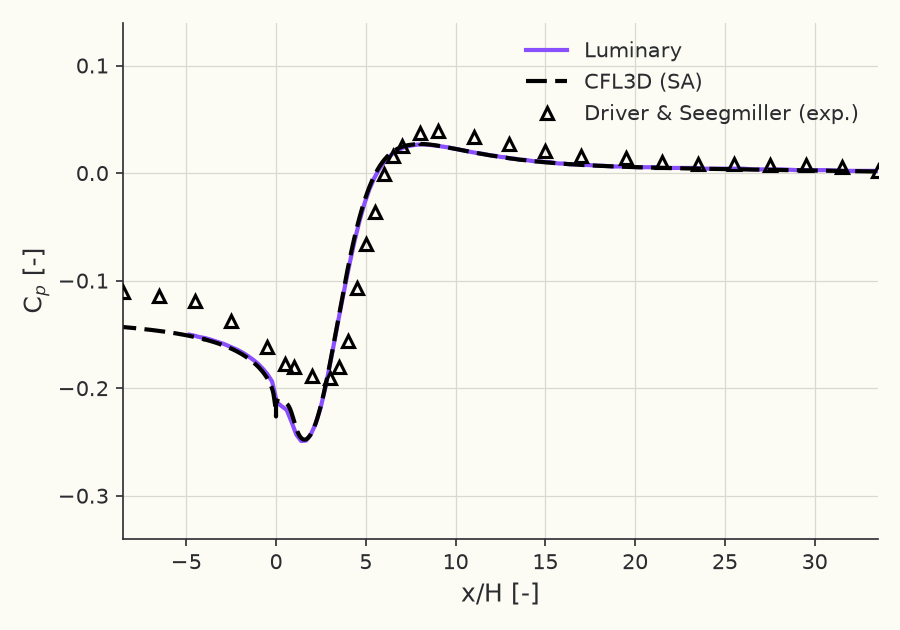
Reference: NASA Langley Turbulence Modeling Resource, "2D Backward Facing Step" (SA model). (CFL3D (SA), lower-wall ): https://tmbwg.github.io/turbmodels/backstep_val_sa.html
Lower-wall skin-friction coefficient
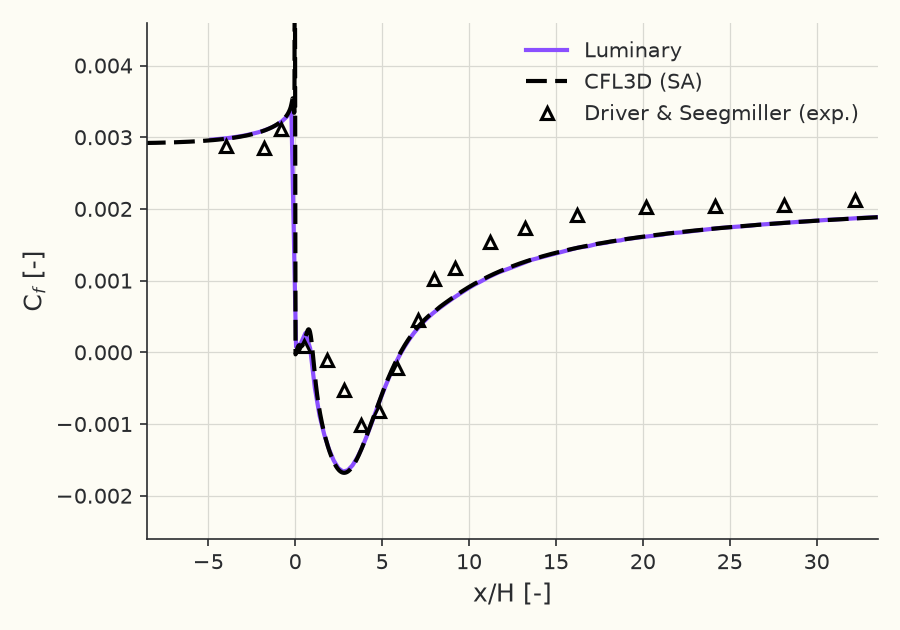
Reference: NASA Langley Turbulence Modeling Resource, "2D Backward Facing Step" (SA model). (CFL3D (SA), lower-wall ): https://tmbwg.github.io/turbmodels/backstep_val_sa.html
Solver configuration
- features exercised
- VerificationValidation2DRANSSpalart–AllmarasIdeal gasSteadyEnergy equation